/filters:no_upscale()/filters:format(webp)/media/8e5d3d5a-8874-4eb4-9977-1f983b13dbcd.jpeg)
Why natural stone stains in the first place.
Marble, limestone, and travertine look solid, but under a microscope they're closer to a very dense sponge. These are porous materials — networks of microscopic channels run through the stone, and liquids that sit on the surface begin wicking down into them.
That's why a coffee ring on a marble vanity or a cooking-oil splash on a limestone floor doesn't always wipe away. Not all stains sit on the surface. Wine, coffee, tea, cooking oils, rust from a metal can, even water carrying minerals — all of these can travel below the polish line and lodge inside the pores of the stone, where no amount of surface scrubbing will reach them.
Two factors decide how deep a stain goes: what spilled (oils penetrate differently than water-based liquids) and how long it sat. A spill blotted up in seconds may leave no trace. The same spill left overnight can become a shadow you'll be looking at for years — unless it's drawn back out properly.
Staining vs. etching: two different problems, two different fixes.
This is the single most common point of confusion we encounter in West Palm Beach homes. A homeowner points to a dull, lighter-colored mark on their marble counter and calls it a stain. Most of the time, it isn't — it's an etch, and the difference matters because the two are repaired in completely different ways.
A stain is something in the stone.
A foreign substance absorbed into the pores — discoloration from within.
- Usually looks darker than the surrounding stone
- Caused by wine, coffee, oil, rust, ink, organic matter
- The finish above it may still be glossy
- Fixed by drawing the substance out — often with a poultice
An etch is damage to the stone.
A chemical burn — acid physically reacting with and dissolving the surface.
- Usually looks lighter, dull, cloudy, or "water-spotted"
- Caused by citrus, vinegar, wine, soda, and acidic or harsh cleaners
- You can often feel a slight roughness
- Fixed by re-finishing the surface — honing and polishing
Why does acid hurt these stones so much? Marble, limestone, and travertine are calcium carbonate — the same mineral family as chalk. Acids react with calcium carbonate on contact, dissolving a microscopic layer of the surface and leaving behind a dull mark where the polish used to be. No cleaner can "remove" an etch, because nothing was added to the stone. Part of the finish is simply gone.
And sometimes it's both at once. Red wine is the classic example: the acid etches the finish while the pigment soaks into the pores. Those repairs need stain extraction and refinishing — one more reason a proper assessment comes before any treatment.
The poultice: how professionals pull stains out from within.
When a stain has penetrated the stone, the only honest fix is to reverse the journey — draw it back up and out through the pores it traveled down. That's what a poultice treatment does.
A poultice is an absorbent paste combined with a chemical agent selected for the specific stain. Oil-based stains, organic stains, rust, and ink each respond to different chemistry, which is why identifying the stain correctly is half the job. The paste is spread over the stain, covered, and left to work — typically 24 to 48 hours. As it slowly dries, it acts like a magnet, pulling the staining agent up out of the stone and into itself.
Deep or long-set stains rarely surrender in one round. It's common for a stubborn stain to need two, three, or more applications, each one lifting the discoloration a little further. Patience is part of the process — and it's far gentler on the stone than aggressive scrubbing or harsh chemicals, which tend to make things worse.
Diamond honing & polishing: rebuilding the finish itself.
Because an etch mark is missing surface — not added substance — the repair is mechanical, not chemical. The damaged layer has to be precisely removed and the finish rebuilt. This is where diamond honing and polishing come in.
Honing uses industrial diamond abrasives, worked in progressively finer grits, to remove a microscopically thin layer of stone — taking the etch damage with it and leaving a uniform, smooth surface. Polishing then refines that surface further, stepping through finer and finer stages until the stone reaches its proper finish, whether that's a soft satin hone or a mirror-gloss shine that matches the rest of the floor or counter.
Done correctly, the repaired area blends invisibly into the surrounding stone. Done incorrectly — with the wrong grit sequence, uneven pressure, or shortcuts — it leaves visible halos and waves. This is genuinely craftsman's work, and it's why etch repair on a visible surface is not a DIY project.
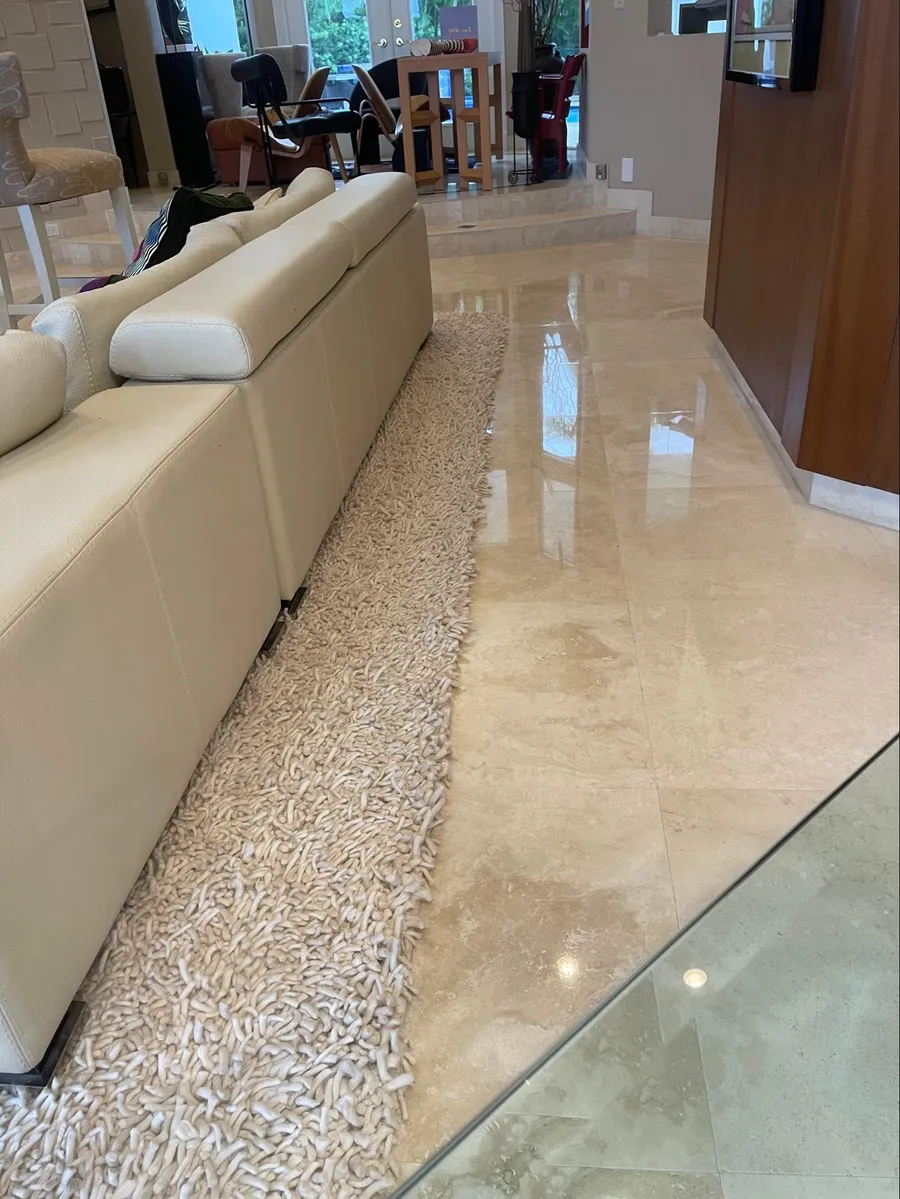
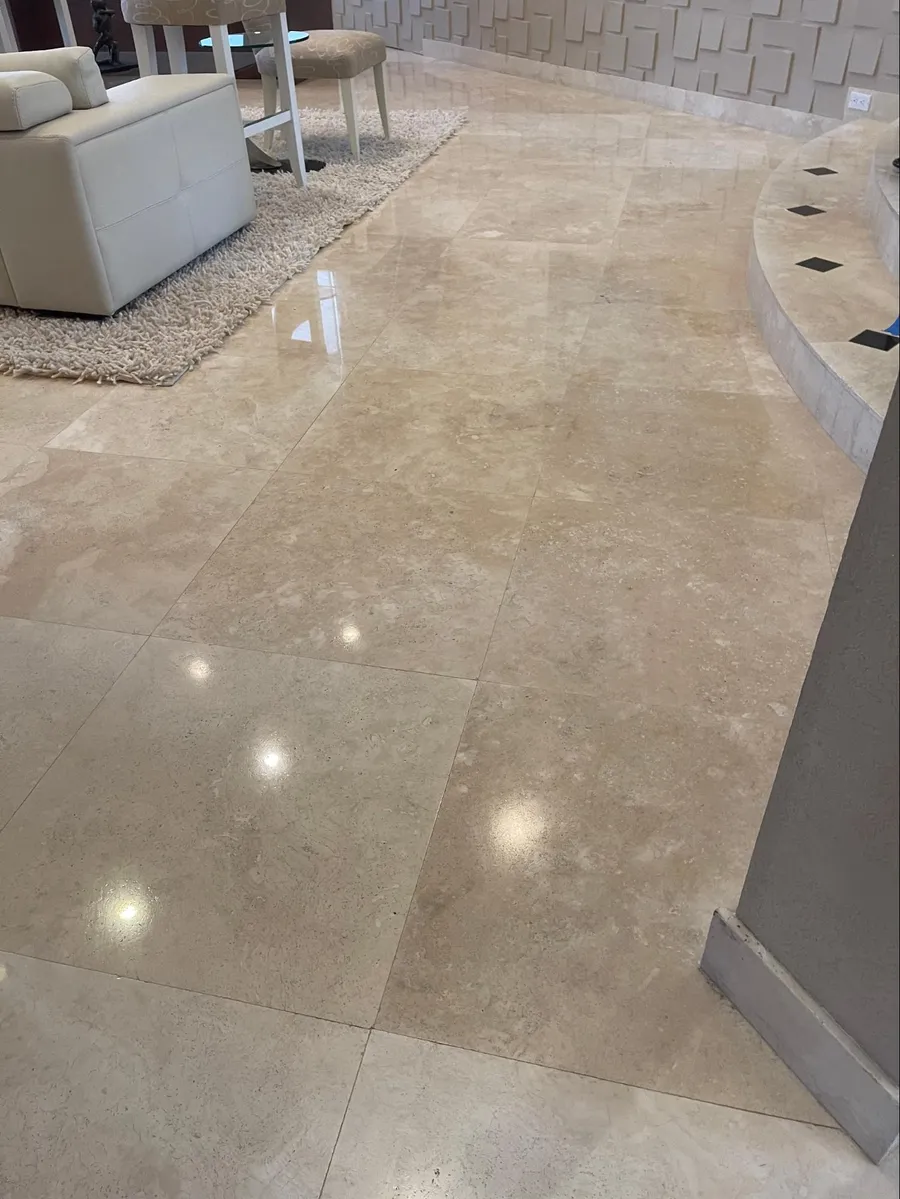
A West Palm Beach travertine floor — dull and worn, then diamond-honed and polished back to a uniform finish by Ultra Marble. See more in our gallery.
Test first. Always.
Here's something the bargain operators won't tell you: every stone and every stain reacts differently. Two travertine floors from different quarries can respond differently to the identical treatment. A poultice formula that lifts an oil stain beautifully from one marble can dull another. Density, mineral content, finish, and age all change the equation.
That's why professional restoration never starts with the visible stain. It starts with a sample test in a small, inconspicuous spot — confirming how your stone responds before anything touches the area you actually look at every day. A full restoration typically moves through five stages:
Sample testing
The stain is identified, and treatments are tested in a hidden area to confirm how the specific stone responds — before any visible surface is touched.
Poultice application
For penetrated stains, a poultice matched to the stain type is applied, covered, and left to draw the discoloration up out of the stone — repeated as needed.
Diamond honing
Etched, scratched, or worn areas are honed with progressively finer diamond abrasives, removing the damaged layer and leveling the surface.
Polishing
The surface is refined to its proper finish — satin, semi-gloss, or full mirror polish — blended seamlessly with the surrounding stone.
Sealing
A quality impregnating sealer is applied, soaking into the pores to slow future absorption and give spills time to be cleaned before they become stains.
Sealing: not stain-proof — stain-resistant.
The last step of a proper restoration is also the most important one for the years ahead: sealing the stone with a quality impregnating sealer.
Unlike a topical coating that sits on the surface, an impregnating (penetrating) sealer soaks into the pores of the stone and cures there, dramatically slowing how fast liquids can be absorbed. The stone still breathes, the finish still looks natural — but a spilled glass of wine now beads and lingers near the surface instead of immediately wicking downward.
Let's be honest about what sealing does and doesn't do, because this is where homeowners are most often misled:
- Sealing does not make stone stain-proof. Nothing does. A spill left sitting long enough can still find its way in.
- Sealing buys you time — often the difference between "wiped it up, no harm done" and a permanent shadow in the stone.
- Sealing does not prevent etching. Acids attack the stone surface itself, above where the sealer lives. Coasters and prompt cleanup are still the defense there.
- Sealer wears down over time and should be reapplied periodically — high-traffic floors and busy kitchen surfaces sooner than rarely-touched ones.
If water no longer beads on your marble or darkens the stone where it sits, your sealer is overdue. Our sealing service is often the single best dollar-for-dollar protection a natural stone surface can get.
What homeowners can do between professional visits.
- Blot spills immediately — blot, don't wipe, so you're not spreading the spill
- Clean with a pH-neutral cleaner made for natural stone
- Use coasters, trivets, and cutting boards on counters
- Use walk-off mats and felt pads on floors
- Reseal on a regular schedule — ask us what's right for your stone
- Use vinegar, lemon, bleach, or ammonia on marble, limestone, or travertine — they etch on contact
- Use abrasive pads or powdered scouring cleansers
- Let "all-purpose" bathroom or tile cleaners near polished stone
- Try internet stain "remedies" without testing — many set the stain or add an etch on top of it
- Wait. The older a stain gets, the deeper it settles
Frequently asked questions.
What's the difference between a stain and an etch mark on marble?
A stain is a foreign substance — wine, oil, coffee, rust — absorbed into the pores of the stone, and it usually looks darker than the surrounding surface. An etch mark is chemical damage to the stone itself, caused when acids react with the calcium carbonate in marble, limestone, or travertine; it usually looks lighter, dull, or cloudy. Stains are drawn out with poultice treatments. Etching is repaired with diamond honing and polishing.
Can I remove a stain from marble myself?
Fresh surface spills can often be blotted up and cleaned with a pH-neutral stone cleaner. But stains that have penetrated into the pores usually require a professional poultice matched to the specific stain type. Using the wrong household chemical can set the stain permanently — or etch the finish, turning one problem into two.
Does sealing make marble stain-proof?
No — and anyone who tells you otherwise is overselling. A quality impregnating sealer slows absorption, giving you more time to clean up a spill before it soaks in. It also doesn't prevent etching, because acids attack the surface itself. Regular resealing is still one of the most effective protections natural stone can have.
What is a poultice treatment?
An absorbent paste combined with a chemical agent chosen for the specific stain type. It's applied over the stain, covered, and left in place — typically 24 to 48 hours. As it dries, it draws the stain up and out of the stone's pores. Deep or older stains may need several applications.
Why do professionals test before treating?
Because every stone and every stain reacts differently. Marble, limestone, and travertine vary in density, mineral content, and finish — a treatment that works perfectly on one surface can damage another. Testing in a small, hidden area first confirms how your stone responds before the visible area is treated.